Four different jobs, often sold as one
Cleaning lifts what is sitting on the stone. Soil, spills, old residue. If your floor is dull because it is dirty, this is all it needs, and it is the cheapest of the four.
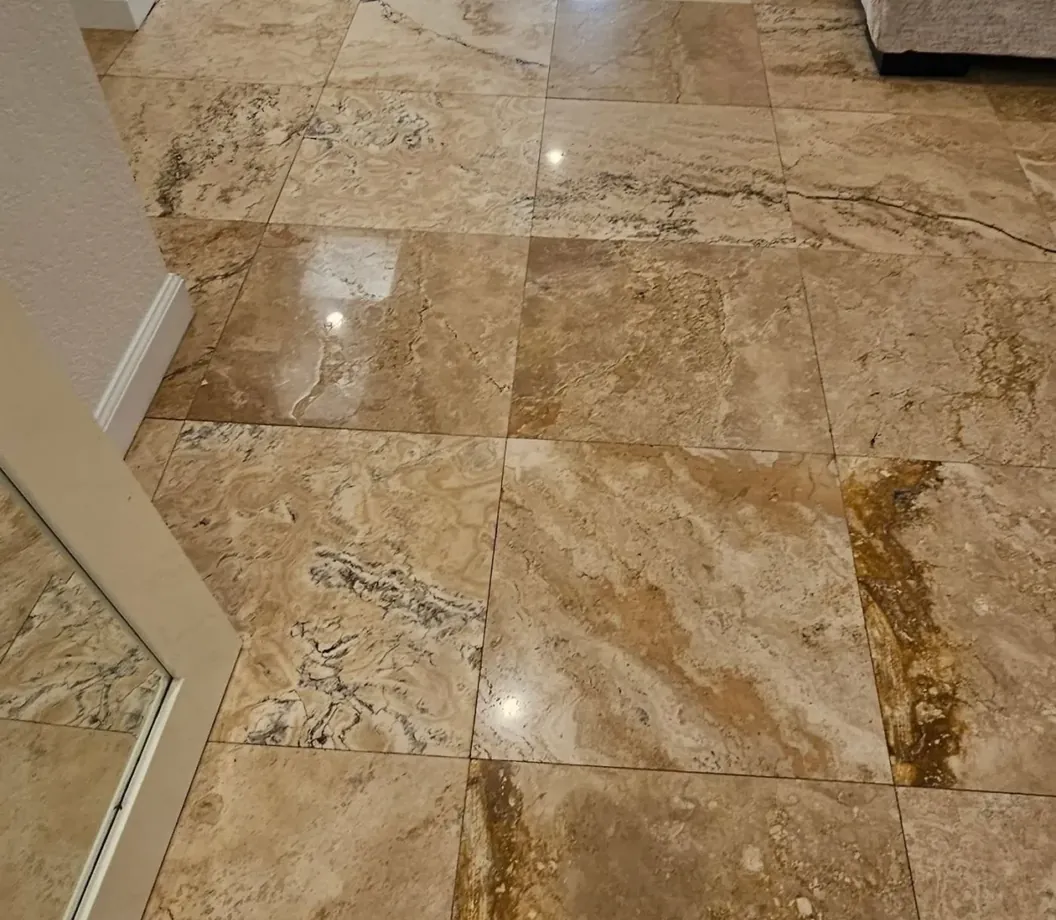
Honing uses diamond abrasives to take a thin layer off the surface of the stone itself. It removes etching, light scratching and wear, and it leaves a matte finish. This is what fixes the dull patches that cleaning will not touch.
Polishing carries on through progressively finer abrasives until the surface reflects. It is honing taken further, which is why a polished finish costs more than a honed one.
Sealing does not change the appearance. A penetrating sealer soaks in and slows staining by keeping spills on the surface long enough to be wiped up. It is not a coating and it does not add shine.
A floor that is simply dirty needs the first. A floor with dull patches needs the second or the third. Nearly every floor benefits from the fourth. Being sold all four when you needed one is how stone care got its reputation.
How the work runs
It starts with identifying the stone, because travertine, marble, limestone, slate, granite and saltillo behave differently and the wrong approach on the right floor causes damage. Travertine and marble are calcite and react to acid. Slate is layered and flakes if worked too hard. Saltillo is porous clay that is stripped and resealed rather than polished.
Cleaning uses a pH-neutral product, because anything acidic etches calcite stone while it works. Where honing or polishing is needed, diamond abrasives are worked across the floor through a sequence of grits, each one removing the scratch pattern left by the one before. Skipping grits is the usual reason a polished floor ends up hazy.
Sealing goes on last, once the surface is finished and dry, and a penetrating sealer is the right kind for a floor. Topical coatings sit on the surface, scuff in the traffic lanes, and eventually have to be stripped.
Looking after it afterwards
Use something pH-neutral and labeled for natural stone. This is the single thing that matters most. The general-purpose sprays, the bathroom descalers and the vinegar solutions are all acidic, and they will etch a calcite floor gradually enough that nobody connects the two.
Get grit off the floor often. On stone, as on everything else, grit under a shoe is an abrasive, and it is what dulls a polished finish first in the routes people walk.
Wipe spills rather than leaving them, particularly citrus, wine, vinegar and anything from a bathroom cabinet. A sealed floor buys you time here, which is the whole point of sealing it.
Use mats at the doors. It is unglamorous and it does more for a stone floor than any product you can buy.
What stone will not come back from
Honing and polishing remove a thin layer, so there is a limit to how many times a floor can be taken back, though for a domestic floor that limit is far away. What does not come back is a chip, a crack, or stone worn through where it has been walked for decades. Lippage, where tile edges stand proud of each other, can be ground flat, but it is a bigger job than it looks.
Ultimate Floor Care cleans natural stone at $0.45 per square foot and polishes at $1.25, across Phoenix, Peoria, and the West Valley. Estimates are free, and part of what an estimate gives you is a straight answer about which of the four jobs your floor actually needs.